Record Tritium Production for Nuclear Weapons
In January 2026, the US National Nuclear Security Administration (NNSA) announced the achievement of a significant milestone in completing a record amount of tritium produced for nuclear weapons.
Tritium is used in nuclear weapons to boost the yield of the fission material of the primary stage. A mixture of tritium and deuterium gas is injected into the pit just before the nuclear chain reaction starts. Fission energy causes tritium and deuterium to fuse and create additional neutrons. Due to its 12.3-year half-life, tritium decays radioactively at the rate of 5.5 percent each year and must be replenished periodically in the warhead’s reservoir. Therefore, tritium needs to be produced unless stocks are available.
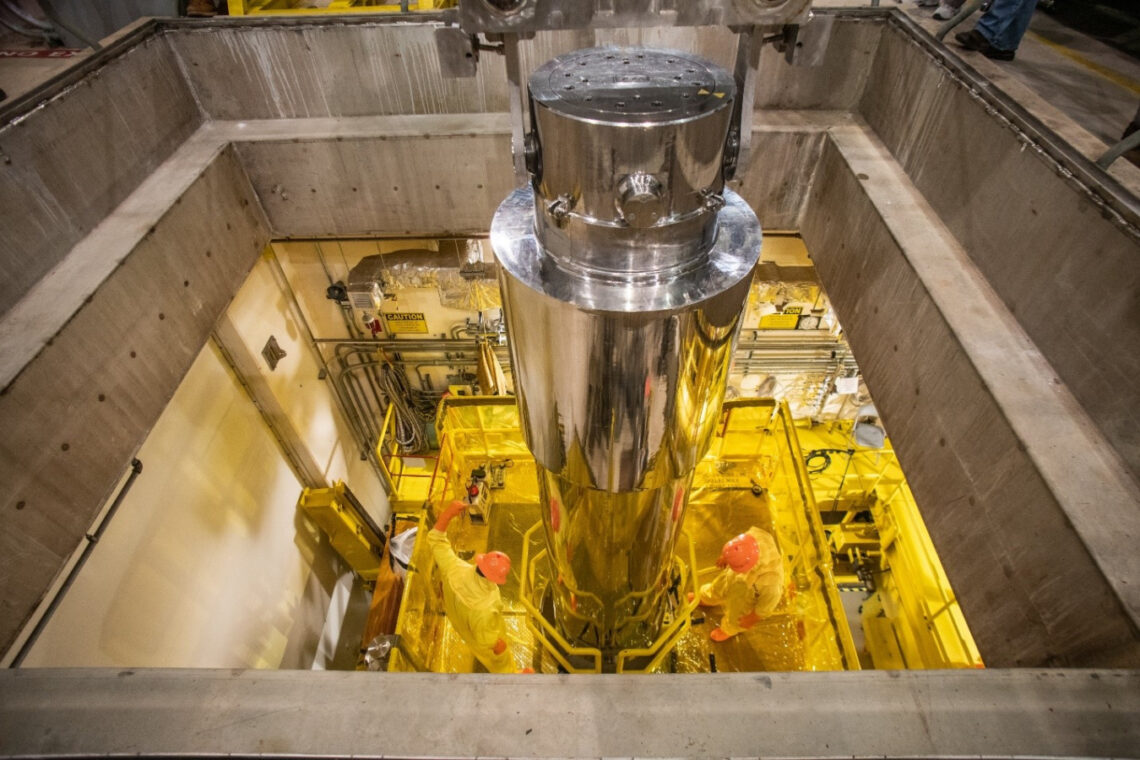
The USA started in 2003 to use commercial nuclear power plants to produce tritium for military purposes. The Watts Bar nuclear power plant Unit 1 operated by Tennessee Valley Authority was selected to irradiate Tritium-Producing Burnable Absorber Rods (TPBARs). These contain lithium which undergoes a nuclear reaction to generate tritium when exposed to the neutron flux. The tritium is extracted by the Savannah River Tritium Enterprises (SRTE) which is operated by Savannah River Nuclear Solutions (SRNS) for NNSA. The new record number is 13 tritium extractions within nine months, spanning fiscal year (FY) 2025 and 2026.
For many years, the tritium extraction facility only needed to conduct a single yearly extraction. In 2017, it started ramping up its production and achieved three extractions. In 2019, the production capacity was doubled. Over the next few years, SRTE continued to increase the number of extractions. The previous record was eight extractions in twelve months, spanning FY 2022 and FY 2023.
Open documents do not disclose the tritium yield per TPBAR. However, combining existing information suggests that each TPBAR is designed to produce on the order of one to a few grams of tritium per full irradiation cycle. The initial production used 240 TPBARs in Watts Bar Unit 1 in 2003. It was foreseen to increase the number of rods per cycle up to no more than a few thousand. Accordingly, the upper estimate of the production capacity is 3000 gram per year (Kalinowski, 2004). The actual recoverable yields are lower due to permeation losses and operational constraints.
Using the estimated global inventories of active nuclear warhead in 2025 (Kristensen et al, 2025) and the most credible estimate by Mark (1993) of 2 to 4 grams of tritium per modern boosted nuclear weapon, the below table provides an estimate of how much tritium needs to be produced each year to replenish the arsenal. This estimate does not include provision of initial inventories for any new nuclear warhead added to the arsenal.
| State | United States | Russia | France | China | U.K. | India | Pakistan | Israel | DPRK |
| Warheads | 3700 | 4309 | 290 | 600 | 225 | 180 | 170 | 90 | 50 |
| Tritium decay per [g/y] | 610 | 711 | 48 | 99 | 37 | 30 | 28 | 15 | 8 |
The United Kingdom does not maintain indigenous production capability and relies on the U.S. supply under mutual defense agreements.
Russia maintains substantial tritium capabilities for its nuclear arsenal. The production facilities are at the Mayak Production Association (Ozersk, Chelyabinsk Oblast) and at the Siberian Chemical Combine (Seversk, Tomsk Oblast). Tritium is retrieved from irradiated lithium targets.
On 18 March 2024, the French Ministry of the Armed Forces announced that France is restarting its production of tritium for military purposes. It is planned to use the same approach as the USA and use commercial nuclear power plants. Lithium‑containing targets will be irradiated by neutrons to breed tritium at the two nuclear power plants operated by Électricité de France(EDF) at Civaux. The first test assemblies were scheduled to be loaded in the reactor in 2025. They will stay in the reactor core for a complete cycle of 16 months before being removed for extracting the tritium. In 2008, France shut down its previous military production facilities at Pierrelatte and Marcoule.
China’s production facilities are not publicly identified, but production could occur as a byproduct in heavy water reactors or with lithium targets in suitable reactors.
India operates a number of CANDU-type reactors. These heavy water reactors can produce tritium as a byproduct in their heavy water moderator and could potentially be used for deliberate tritium production through lithium target irradiation. India uses the CIRUS and Dhruva reactors at the Bhabha Atomic Research Centre, Trombay.
Pakistan operates the Khushab reactors (Punjab) which are heavy water reactors primarily for plutonium production, but capable of producing tritium.
Israel operates at the Negev Nuclear Research Center (Dimona) a heavy water reactor capable of tritium production.
Yongbyon Nuclear Scientific Research Center of North Korea includes reactors that could produce tritium.
All historic tritium production facilities for civilian or military purposes are described in the book by Kalinowski (2004): “International Control of Tritium for Nuclear Nonproliferation and Disarmament”.