
Exploring Atmospheric Nuclear Tests
Radionuclides released by nuclear test are still widely abundant in the environment and biosphere. Most releases were caused by the nuclear atmospheric test. The last one was conducted by the People’s Republic of China on October 16, 1980. It was the last known atmospheric detonation before the Comprehensive Nuclear-Test-Ban Treaty (CTBT) was negotiated in from 1993 to 1996.
With regard to limiting the environmental releases of radioactivity, the major landmark was the Partial Test Ban Treaty (PTBT) of 1963. which bans tests in the atmosphere, outer space, and underwater.
On August 5, 1963, the PTBT was signed by the three original Depositary Governments, the Union of Soviet Socialist Republics (USSR), the United Kingdom of Great Britain and Northern Ireland, and the United States of America. France conducted its last atmospheric tests in 1974 and eventually signed onto the treaty. China acceded to the Partial Test Ban Treaty (PTBT) in 1980. As of today, over 130 states are party to the treaty.
Only a few radionuclides remain relevant after 45 to 80 years, as they have a high yield and a half-life of more than ten years. These are
- Fission products: H-3 (12.32 years), Eu-152 (13.5 years), Sr-90 (28.8 years), Cs-137 (30.17 years), Tc-99 (211,000 years), Cl-36 (301,000 years)
- Actinides: Am-241 (432.2 years), Pu-240 (6,560 years), Pu-239 (24,100 years), U-235 (704 million years)
- Activation products: C-14 (5,730 years), Ba-133 (10.5 years), Eu-152 (13.5 years)
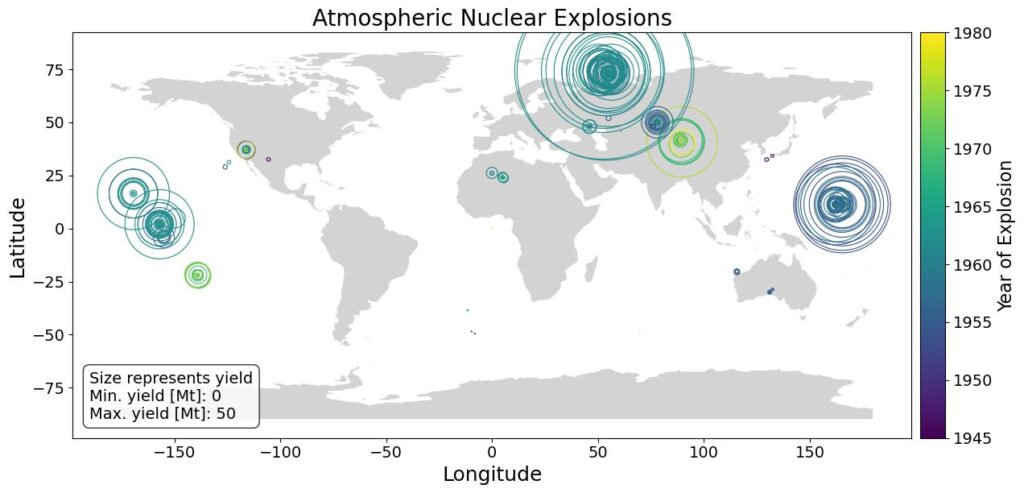
The map shows the location of all 528 atmospheric nuclear tests with the marker size being proportional to the total energy yield and the marker color coding representing the time it was conducted.
This dataset was prepared by Peace Science Collaboration for projects conducted in cooperation with several partners. Please submit a request in case you wish to see a local map zoomed in to a certain nuclear test site or a global map highlighting other parameters.
