Atmosphere
-
Borders in the Sky: How Radioactive Venting Tested the Limited Test Ban Treaty
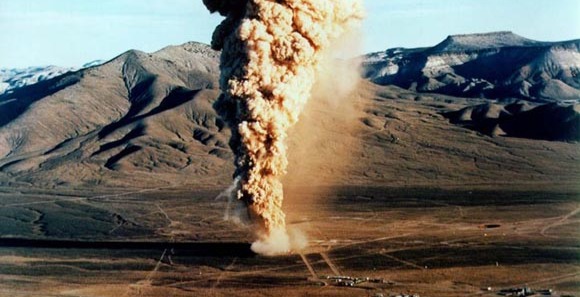
Introduction The 1963 Limited Test Ban Treaty (LTBT) marked a historic milestone in international arms control, seeking to curb environmental fallout by forcing nuclear testing underground. However, early underground programs demonstrated that preventing volatile radionuclides from crossing national borders was far more technically complex than treaty signatories had anticipated. Key Facts: Limited Test Ban Treaty (LTBT) Transboundary Venting and Early Treaty Compliance Underground cratering experiments and containment failures repeatedly challenged the practical boundaries of LTBT compliance. As documented in comprehensive reviews of historic remote atmospheric radionuclide monitoring, nuclear debris from underground test venting and atmospheric releases was frequently observed in multiple countries across the whole hemisphere (Kalinowski & Trillo, 2025).…
-
Global inventory of Cs-137 from nuclear tests
The total activity of 137Cs discharged into the atmosphere by all 535 atmospheric nuclear explosions was around 1018 Bq. This is much more than from the Chernobyl and Fukushima accidents. For Fukushima, the amount of 137Cs released is estimated to be 1.2 × 10¹⁶ Bq and this is about 14% of the emission estimated for the Chernobyl accident (Steinhauser et al., 2014). Some of the 137Cs inventory in the environment has already decayed but the half-life of 30.04 years implies that a large portion persists. Today’s remaining ¹³⁷Cs inventory from atmospheric nuclear tests is on the order of 2–3 × 10¹⁷ Bq. A more precise estimate will be determined by a project…
-
Exploring Atmospheric Nuclear Tests
Radionuclides released by nuclear test are still widely abundant in the environment and biosphere. Most releases were caused by the nuclear atmospheric test. The last one was conducted by the People’s Republic of China on October 16, 1980. It was the last known atmospheric detonation before the Comprehensive Nuclear-Test-Ban Treaty (CTBT) was negotiated in from 1993 to 1996. With regard to limiting the environmental releases of radioactivity, the major landmark was the Partial Test Ban Treaty (PTBT) of 1963. which bans tests in the atmosphere, outer space, and underwater. On August 5, 1963, the PTBT was signed by the three original Depositary Governments, the Union of Soviet Socialist Republics (USSR),…