In 2003, I wrote an article in German reflecting on my first five years as a physicist working with an international organization in Vienna: the CTBTO. Its full name is the Provisional Technical Secretariat of the Preparatory Commission for the Comprehensive Nuclear-Test-Ban Treaty Organization (CTBTO).
After completing my first term there, I returned to academia as a university professor and collaborated on a research project with the International Atomic Energy Agency (IAEA). Later, I rejoined the CTBTO and spent another twelve years contributing to its mission.
Today, I work as a freelancer, helping to make nuclear science actionable for international peace and security, and supporting scientists as they grow and thrive in their careers.
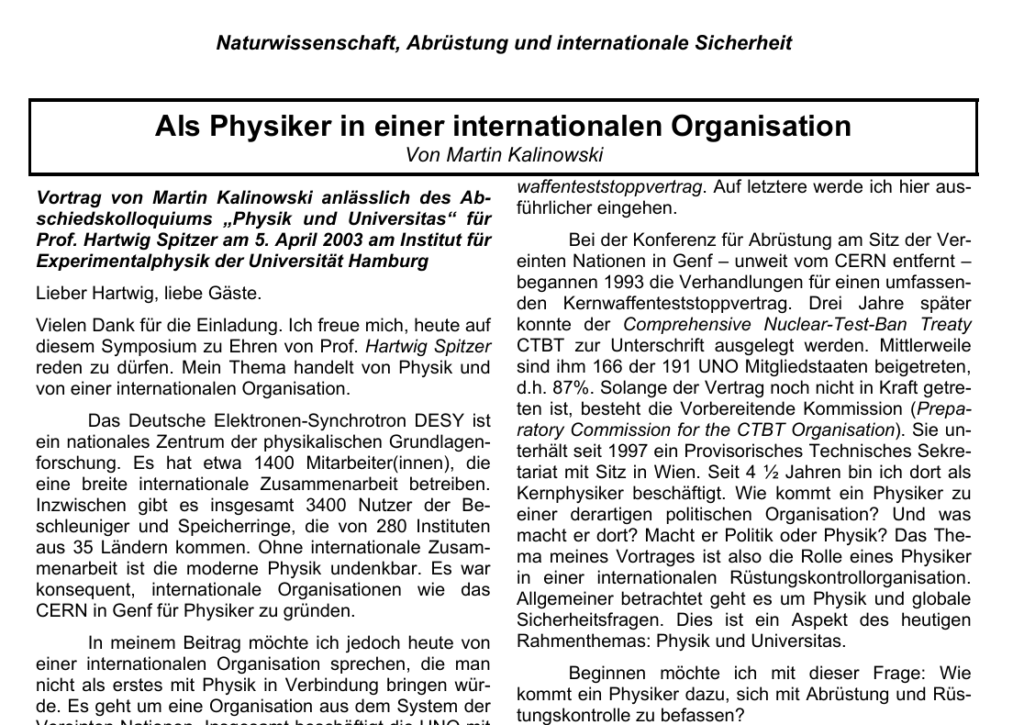
This is an excerpt from my article translated into English:
The closest interface between the scientific community and the Provisional Technical Secretariat is Working Group B of the Preparatory Commission. This working group meets three times a year for two to three weeks in Vienna. The delegates sent by the Member States are mostly natural scientists. They deal with the questions, plans, and decisions for which their expertise is required. Nowhere else is the political–scientific interaction conducted as intensively as in this body. Every scientific statement is made in the name of a Member State. Every participating scientist represents the interests of their country. The interesting question is whether and how political influence affects science and its results.
Much of what I wrote in 2003 is still relevant today. Yet the world has changed profoundly—both in terms of international politics and in the technologies and scientific advances that shape our work.
If you have questions or would like to draw on my experience, feel free to reach out. You might be interested in topics such as:
How to find opportunities as a scientist at an international organization
How to prepare a successful application for such positions
How to collaborate effectively with international organizations as a scientist
How to navigate the science–policy interface
You can learn more about my early career as an emerging scientist—and my first steps at the science–policy boundary—by reading the original article on pages 3 to 7 of the FONAS Newsletter 5/2003.
The following quote reflects a core part of my motivation to work for nuclear disarmament and arms control:
I still remember a lecture on reactor neutron physics in which the professor, pointing to a simple equation on the blackboard, said: “In a reactor you want to keep this parameter close to 1; if it is significantly greater than 1, then you have the bomb.” He was referring to what is known as criticality. That exemplifies how closely the scientific fascination with the underlying physics of the atomic nucleus and the horror of Hiroshima and Nagasaki lie together—inseparable.
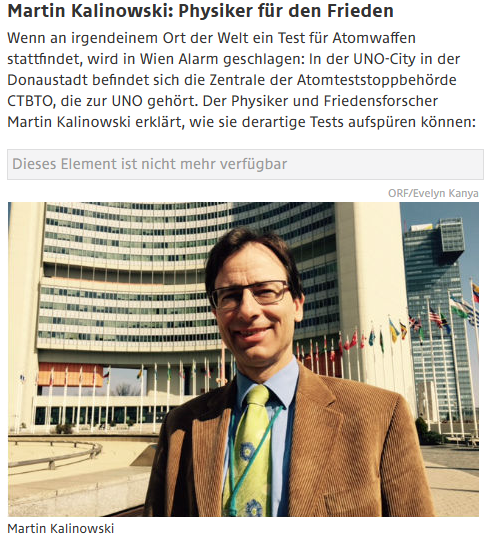
Screenshot: 10 years ago, I was interviewed by Austria’s national public broadcasting service ORF and briefly portrayed on their website https://wien.orf.at/v2/radio/stories/2766182/