Global inventory of Cs-137 from nuclear tests
The total activity of 137Cs discharged into the atmosphere by all 535 atmospheric nuclear explosions was around 1018 Bq. This is much more than from the Chernobyl and Fukushima accidents. For Fukushima, the amount of 137Cs released is estimated to be 1.2 × 10¹⁶ Bq and this is about 14% of the emission estimated for the Chernobyl accident (Steinhauser et al., 2014). Some of the 137Cs inventory in the environment has already decayed but the half-life of 30.04 years implies that a large portion persists. Today’s remaining ¹³⁷Cs inventory from atmospheric nuclear tests is on the order of 2–3 × 10¹⁷ Bq. A more precise estimate will be determined by a project of Peace Science Collaboration that started last year.
Is this of concern? According to UNSCEAR (1993), in the medium-term, 137Cs accounts for 13% of the total effective dose resulting from nuclear tests. This isotope is found in the food chain and may accumulate. For example, Stäger et al. (2023) studied the origin of 137Cs in wild boars in Bavaria. The contribution from weapons fallout to the total level is significant (10−68%) in those specimens that exceeded the regulatory limit by a factor of up to 25. Contemporary analyses using UNSCEAR dose data and ICRP cancer‑risk coefficients typically find between 430,000 (Makhijani et al., 2007) and 500,000 (v. Hippel, 2022) excess cancer deaths worldwide are resulting from all atmospheric nuclear tests combined.
A database of atmospheric nuclear explosions was assembled from various sources and curated by Dr. Martin Kalinowski. The editing was done in cooperation with the research team of Professor Andreas Stohl at the Department of Meteorology and Geophysics University of Vienna.
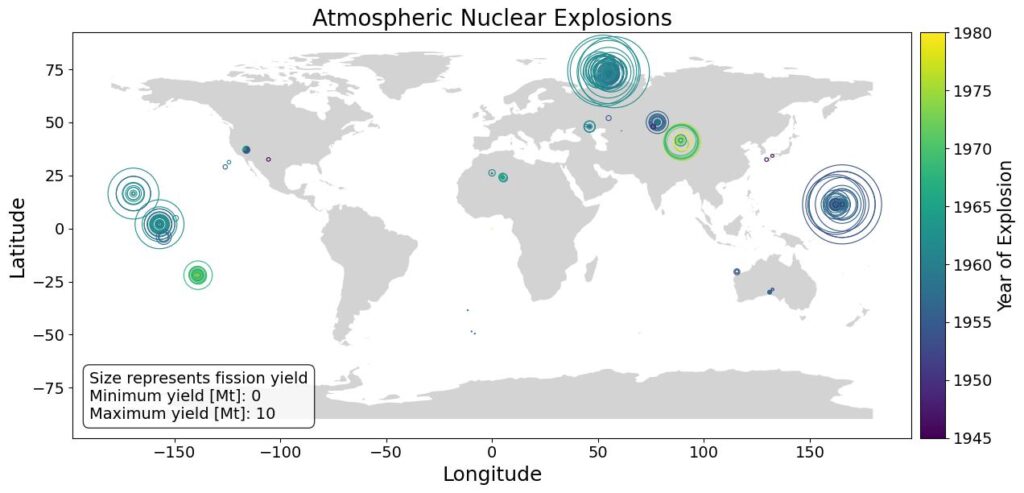
In total, there are 535 atmospheric nuclear explosions that have non-zero energy release. The map shows the locations with the size of the circle being proportional to the fission yield and the color coding indicating the time of the explosion. The activity of any fission isotope injected into the atmosphere by each explosion and the cumulative inventory as it changes over time can be estimated and decay corrected.
The 137Cs source term is calculated using the estimated fission yield of each explosion. The comparison between our table and the data provided by UNSCEAR (2000) is perfect for the total yield (65.0% vs 66% for the 25 largest explosions) but our total is larger for the fission portion (55.6% rather than 55%). The differences reflect the updates that we made. When taking only the 75 explosions into account that are above 1,000 kT TNT equivalent, their accumulated yield accounts for 90.2% of all 535 explosions and 85.2% of the total fission yield.
The largest ever achieved yield was 50,000 kT known as Tsar Bomba and conducted by the Soviet Union on 30 October 1961. The biggest share of its yield was due to nuclear fusion and 1,500 kT caused by fission. That is just 3%. This is the lowest fission energy share of any thermonuclear test. There was never a test without fission reactions because the fusion stage needs to be ignited with a fission explosion. Most nuclear explosions had no fusion component, but 165 tests did.
Andreas Stohl is inventor of the atmospheric transport model Flexpart (Stohl et al., 2005) and maintains its further development. His group will use the source term of 137Cs described here to simulate its atmospheric dispersion and deposition. Stay tuned to learn about the results as they become available.
References
Stäger, F., Zok, D., Schiller, A. K., Feng, B., & Steinhauser, G. (2023). Disproportionately high contributions of 60 year old weapons-137Cs explain the persistence of radioactive contamination in Bavarian wild boars. Environmental Science & Technology, 57(36), 13601-13611. https://doi.org/10.1021/acs.est.3c03565
Makhijani, A., Hu, H., & Yih, K. (2007). Science for the vulnerable: Setting radiation and multiple exposure environmental health standards to protect those most at risk. Institute for Energy and Environmental Research.
Steinhauser, G., Brandl, A., & Johnson, T. E. (2014). Comparison of the Chernobyl and Fukushima nuclear accidents: A review of the environmental impacts. Science of the Total Environment, 470–471, 800–817. https://doi.org/10.1016/j.scitotenv.2013.10.029
Stohl, A., Forster, C., Frank, A., Seibert, P., & Wotawa, G. (2005). The Lagrangian particle dispersion model FLEXPART version 6.2. Atmospheric Chemistry and Physics, 5(9), 2461–2474. https://doi.org/10.5194/acp-5-2461-2005
von Hippel, F. (2022). The long-term global health burden from nuclear weapon test explosions in the atmosphere: Revisiting Andrei Sakharov’s 1958 estimates. Science & Global Security, 30(2), 54–61. https://doi.org/10.1080/08929882.2022.2105844
United Nations Scientific Committee on the Effects of Atomic Radiation. (1993). Sources and effects of ionizing radiation. UNSCEAR 1993 report to the General Assembly, with scientific annexes. United Nations, New York.
United Nations Scientific Committee on the Effects of Atomic Radiation. (2000). Sources and effects of ionizing radiation. UNSCEAR 2000 report to the General Assembly, with scientific annexes. United Nations, New York.


You May Also Like
Exploring Atmospheric Nuclear Tests