New Era for Tritium Trade
From Untapped Stocks to High Production Driven by Fusion Startups.
For decades, the global tritium market has been a quiet, almost invisible niche. Civilian demand remained at a few hundred grams per year, supplied mainly by Canada’s heavy‑water reactors. Fusion startups are now poised to change this landscape entirely.
The world is entering a period in which tritium demand will increase by two orders of magnitude. Decades‑old civilian stocks will be drawn down, and new production capacity will be required to support the emerging fusion industry.
This post summarizes key findings and expands on themes previously discussed on the Tritium Matters Working Group (TMWG) homepage.
Fusion startups: the new drivers of tritium demand
At least twelve startups across six countries are pursuing deuterium–tritium (DT) fusion concepts, including spherical tokamaks, stellarators, laser inertial fusion, and magnetized target fusion. These companies are not theoretical ventures; they are building hardware, raising capital, and planning pilot plants for the early 2030s. In parallel, several laboratories are intensifying research on tritium breeding, quantification, and processing.
Startup tritium needs fall into three categories:
- Initial inventory (the imminent requirement)
- Makeup fuel (to compensate for decay and operational losses)
- Operational self‑sufficiency (breeding tritium while burning it)
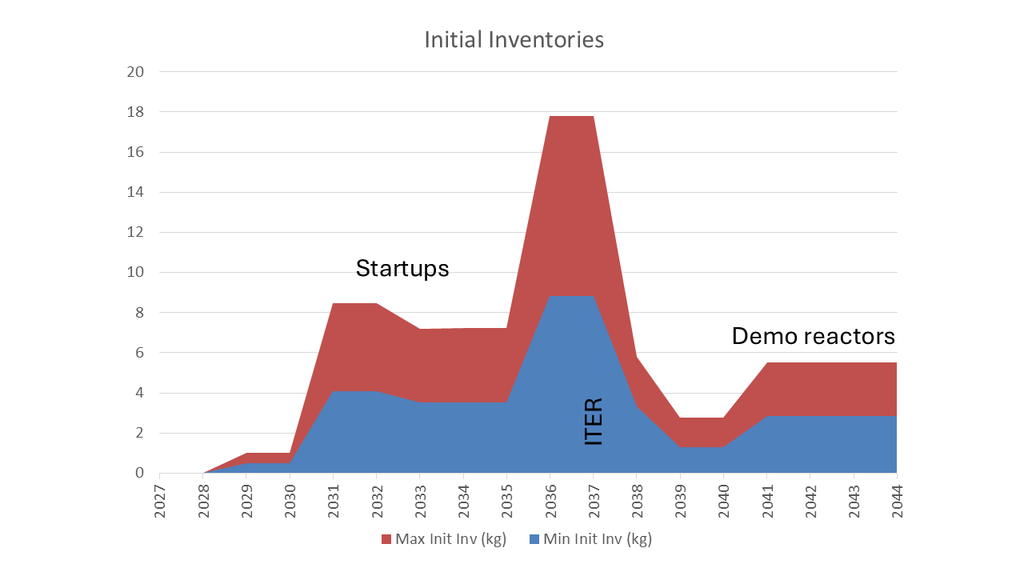
The timeline for initial inventory demand is shown in the above figure. Lower estimates appear in blue, higher estimates in red. Dates are based on company announcements; tritium quantities are best estimates derived from technology choices and planned electric power levels (see the TMWG post for details).
Most startups intend to begin DT operation before ITER conducts its first DT plasma test in 2037. Large research and demonstration reactors are planned for the 2040s. The decline after 2037 may not occur if additional facilities begin operation beyond the twelve startups considered here.
ITER, DEMO, and other high‑power DT machines require kilogram‑scale inventories, dominated not by plasma fuel but by fuel‑cycle systems, storage, and processing infrastructure. Startup designs aim to operate with much smaller inventories, but their larger number results in higher cumulative annual consumption than the demonstration reactors.
Based on current technology choices and planned power levels:
- Startups will collectively require 42–85 kg during the 2030s.
- ITER will begin DT operation with 2–3 kg in 2037.
- Peak demand for initial inventories may exceed 10 kg/year.
- In the 2040s, fusion plants may burn up to 500 kg/year.
- Even with successful breeding blankets, external supply will still need to provide ≈10 kg/year.
Despite uncertainties, these numbers clearly indicate a dramatic shift from today’s civilian market of roughly 100 grams per year.
Where will the tritium come from?
The only significant civilian source is inadvertent tritium generation in pressurized heavy‑water reactors (PHWRs) such as CANDU reactors, where neutrons are captured by deuterium in the moderator. The current price is approximately 30,000–40,000 USD per gram.
Only two industrial‑scale detritiation facilities exist:
- Tritium Removal Facility of Ottawa Power Generation (OPG, Darlington, Canada) – estimated stock: ~35 kg
- Wolsong Tritium Removal Facility (Republic of Korea) – estimated stock: ~5.7 kg
Global civilian production of ~2.5 kg/year is dominated by Canada.
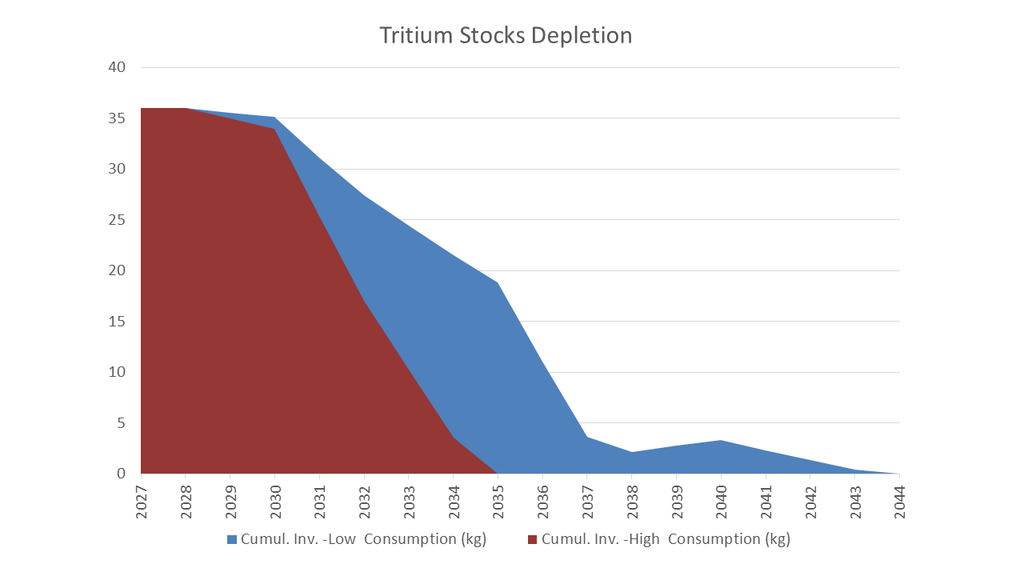
The figure illustrates projected Canadian tritium stocks over the next two decades, assuming they remain the sole source and no additional demand arises beyond startup and demonstration reactor needs.
- Minimum startup demand can be met by OPG alone.
- Maximum startup demand would exhaust OPG stocks by 2035.
- After 2035, new production capacity may become essential.
This marks the first time civilian tritium supply will face sustained pressure. Fusion plants will require continuous replenishment to compensate for tritium burned as fuel. This requirement is not included here because operating fusion reactors are expected to breed their own fuel using fusion neutrons and lithium.
Civilian vs military tritium domains
Tritium is used in nuclear weapons primarily to boost explosive yield. Military inventories are large and must be replenished to offset radioactive decay of 5.5% per year, requiring dedicated production facilities.
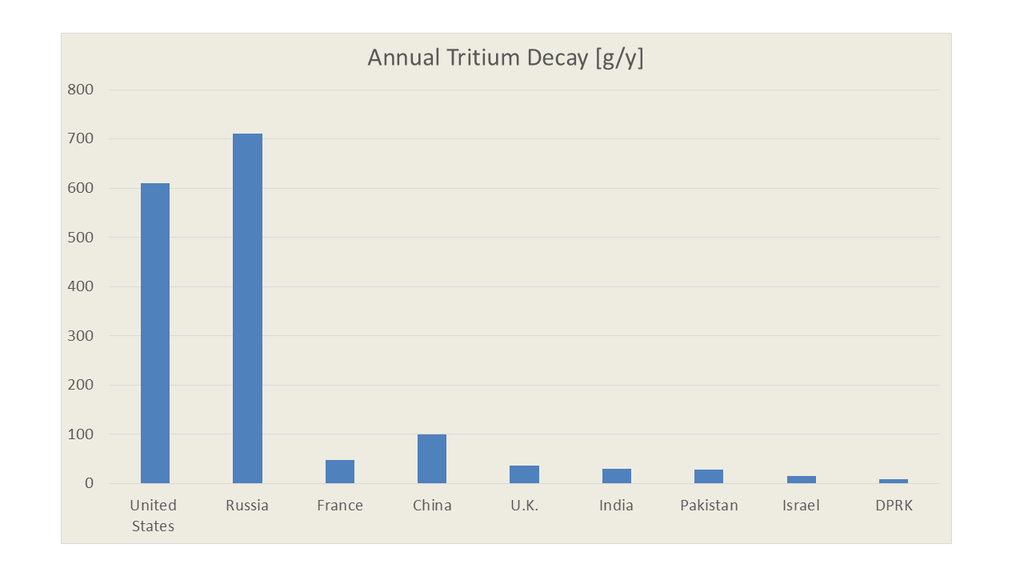
The figure provides an indicative summary of annual tritium production needs for nuclear‑weapon states. However, military tritium is not accessible to civilian fusion programs. Strict institutional separation between military and civilian domains is essential for non‑proliferation. Civilian fusion deployment must therefore rely entirely on civilian supply chains, even though new civilian production technologies may resemble those used for military tritium.
As civilian tritium flows increase, preventing diversion into military stockpiles will become more challenging. This reinforces the need to strengthen and further develop existing international tritium control arrangements (see Kalinowski, 2004).
Commercial tritium market: awakening from dormancy
Historically, commercial tritium manufacturers purchased only gram‑scale quantities for self‑luminous devices. Larger amounts – up to tens of grams – were procured under government‑to‑government agreements for major research projects such as JET (UK), ITER (France), TFTR (USA), TLK (Germany), and TSTA (USA).
This market is now transforming and fusion startups are the catalyst. Tritium, long a niche isotope with limited civilian use, is becoming a strategic resource at the heart of the emerging fusion economy. Before fusion reactors become self‑sufficient, they will consume grams to kilograms each. Tritium is becoming a strategic commodity.
Key conclusions:
- In the 2030s, tritium trade will rise from hundreds of grams to several kilograms per year.
- In the 2040s, demand will increase to tens of kilograms per year.
- Untapped stocks may be consumed by startups by the mid‑2030s, requiring additional production capacity.
- Civilian fusion deployment will rely entirely on civilian supply chains.
- Military production technologies offer lessons but not supply.
- Non‑proliferation concerns will intensify as civilian tritium flows grow.
The transition from untapped tritium reserves to high-volume production is already underway. Over the next decade, global tritium trade is expected to grow substantially as it becomes a critical input for the fusion industry. This growth poses a significant challenge for non-proliferation efforts, which must ensure that tritium intended for peaceful fusion applications does not find its way into military use.

You May Also Like

Global inventory of Cs-137 from nuclear tests