Borders in the Sky: How Radioactive Venting Tested the Limited Test Ban Treaty
Introduction
The 1963 Limited Test Ban Treaty (LTBT) marked a historic milestone in international arms control, seeking to curb environmental fallout by forcing nuclear testing underground. However, early underground programs demonstrated that preventing volatile radionuclides from crossing national borders was far more technically complex than treaty signatories had anticipated.
Key Facts: Limited Test Ban Treaty (LTBT)
- Signed: August 5, 1963 (Entry into force: October 10, 1963)
- Key Signatories: USA, USSR, UK
- Core Prohibition: Bans nuclear explosions in the atmosphere, outer space, and underwater, as well as underground tests that cause radioactive debris to cross international borders.
- Historical Significance: A landmark early arms control and environmental agreement that effectively pushed nuclear weapons testing deep underground.
Transboundary Venting and Early Treaty Compliance
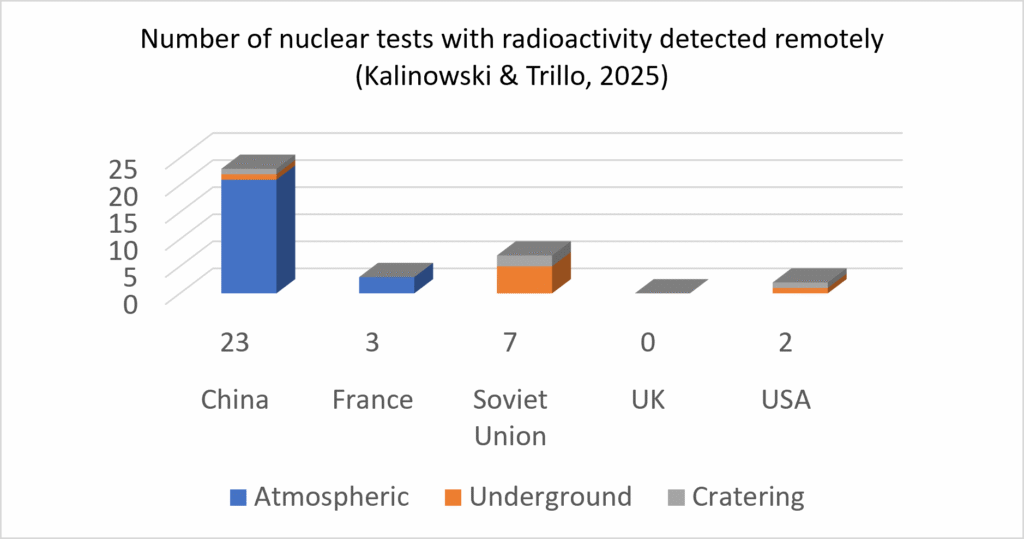
Underground cratering experiments and containment failures repeatedly challenged the practical boundaries of LTBT compliance. As documented in comprehensive reviews of historic remote atmospheric radionuclide monitoring, nuclear debris from underground test venting and atmospheric releases was frequently observed in multiple countries across the whole hemisphere (Kalinowski & Trillo, 2025).
The Soviet Union’s Chagan test on January 15, 1965, was a 140-kiloton “Peaceful Nuclear Explosion” (PNE) underground excavation experiment designed to evaluate cratering for artificial reservoirs. It vented roughly 20% of its radioactive inventory. Soviet authorities claimed that Chagan was the only test they conducted after the LTBT entered into force that resulted in cross-boundary radionuclide movement. Following the explosion, a significant plume entered the atmosphere, and nuclear debris was detected in Japan (Koyama et al., 1966).
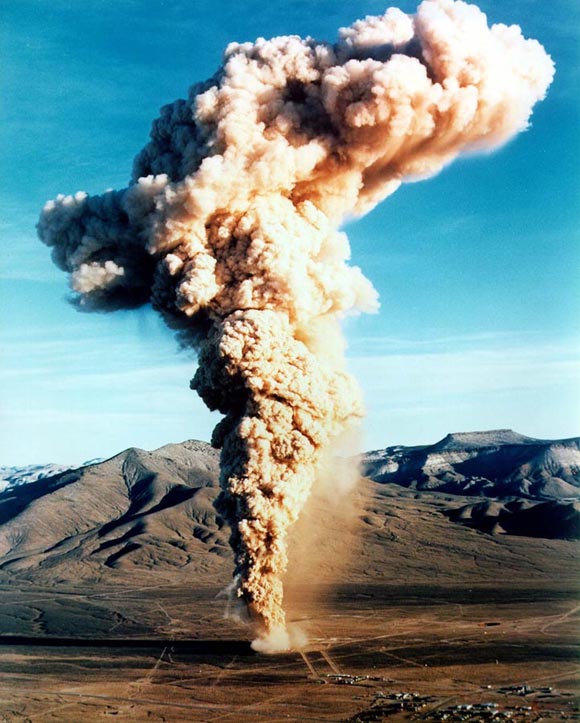
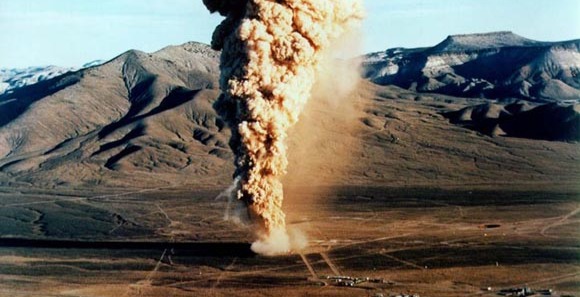
Reciprocally, the United States suffered a major containment breach during the Baneberry test on December 18, 1970, at the Nevada Test Site. A fissure release vented radionuclides up to 3 kilometers into the atmosphere (see image at the bottom of this post), creating a plume that migrated north into Canada and produced fallout observed as far away as Sweden (De Geer, 1991).
Behind Closed Doors: Mutual Complaints and the “Gentleman’s Agreement”
When these containment failures occurred, they initially led to sharp diplomatic exchanges. The United States formally requested explanations from Moscow following the Chagan test in 1965, and the Soviet Union made representations to Washington after the Baneberry incident in 1971. Rather than escalating venting incidents into formal treaty violations with formal legal sanctions under the LTBT, Washington and Moscow primarily handled containment breaches through diplomatic channels. Both superpowers recognized the inherent difficulty of total underground containment for large or shallow explosions.
Yet, the initial public complaints quickly threatened to derail the broader testing framework. Recognizing that public accusations could inflame anti-nuclear sentiment and compromise their respective underground testing programs, Washington and Moscow quietly adopted an unwritten, tacit “gentleman’s agreement”. Under this informal understanding, both nuclear weapon states agreed to stop publicly accusing each other of treaty violations over accidental venting incidents, choosing instead to handle grievances quietly via private diplomatic channels. This covert consensus was only fully revealed decades later when historian William Burr published declassified State Department files through the National Security Archive (Burr, 2013).
Non-Signatory Reactions Perspectives and Current State-of-the-Art
Bordering and neutral nations faced a delicate balance when detecting unexpected fallout. Following the Baneberry release, Canada made an official, low-key oral representation to the United States. Crucially, Canadian diplomats explicitly clarified that they had no intention of lodging a formal protest or treating the event as a formal treaty violation. Likewise, when Sweden and Finland detected elevated radiation levels from a 1987 Soviet test at Novaya Zemlya, both nations sought explanations and expressed concern without issuing formal public notices of treaty violation. Formal legal complaints remained rare, as nations sought to avoid diplomatic escalation over complex, hard-to-prove transboundary flows.
What was once a subject of diplomatic ambiguity and attribution doubt has been transformed by modern science. Today, sophisticated atmospheric transport calculations enable researchers and treaty verifiers to assign radioactive detections made by the Comprehensive Nuclear-Test-Ban Treaty Organization’s (CTBTO) International Monitoring System back to their exact origin with high precision and confidence.
This high-confidence attribution capability was clearly demonstrated following the announced underground nuclear tests by the Democratic People’s Republic of Korea (DPRK) in 2006 and 2013. In both instances, the IMS successfully detected atmospheric releases of radioxenon that were conclusively linked to the test time and location via atmospheric transport modeling and isotopic ratio analysis (Kalinowski & Trillo, 2025).
Conclusion
The physical realities of radionuclide venting into the atmosphere routinely crossed political boundaries, challenging early legal frameworks like the LTBT. The evolution from early containment failures like Chagan and Baneberry to the high-precision noble gas detection of the IMS demonstrates how atmospheric monitoring has matured into an indispensable tool for global nuclear verification. Modern verification technologies ensure that no radioactive trace in the atmosphere goes unnoticed or unverified.
References
- Burr, W. (Ed.). (2013, August 2). The Limited Test Ban Treaty – 50 Years Later: New Documents Throw Light on Accord Banning Atmospheric Nuclear Testing. National Security Archive Electronic Briefing Book No. 433. https://nsarchive2.gwu.edu/nukevault/ebb433
- De Geer, L.-E. (1991). Observations in Sweden of venting underground nuclear explosions. Paper prepared for Symposium on Underground Nuclear Weapons Testing: Potential Environment Impacts and their Containment. Ottawa, Canada, 23–24 April 1991.
- Kalinowski, M. B., & Trillo Tinoco, F. E. (2025). Overview of Remote Atmospheric Radionuclide Monitoring Data Associated with Historic Nuclear Explosions. Pure and Applied Geophysics, 182, 5225–5234. https://link.springer.com/article/10.1007/s00024-024-03632-x
- Koyama, S., Sotobayashi, T., & Suzuki, T. (1966). Highly fractionated nuclear debris resulting from the venting of a Soviet underground nuclear test. Nature, 209, 239–240. https://www.nature.com/articles/209239a0